Epitalon, cells and longer lives
The wish for more years travels through several very different experiments. The pineal extract and the synthetic tetrapeptide also have separate records.
The pineal extract
Epitalon's history begins with Epithalamin, a polypeptide extract of the bovine pineal gland. The synthetic tetrapeptide was developed around that extract's amino-acid composition. The 2025 overview of Epitalon gathers the resulting research on telomeres, melatonin and ageing.
Turning an extract into a defined molecule sharpens the experimental question. That part of the project appeals to me. The evidence still has to follow that molecule. In particular, the long human follow-up used Epithalamin, whereas the familiar telomere experiments used synthetic Epitalon. That distinction affects how much of the longevity story can travel with the name.
What it is
Epitalon is the linear tetrapeptide H-Ala-Glu-Asp-Gly-OH, a synthetic molecule derived from the amino-acid composition of epithalamin, a polypeptide extract of the bovine pineal gland. It appears in the literature as epithalon, epithalone, the AEDG peptide, the AEDG tetrapeptide, or simply Ala-Glu-Asp-Gly.
One naming distinction is worth holding onto, because it is the most common error in material written about this compound. Epithalamin is the bovine pineal extract; epitalon is the synthetic tetrapeptide. They are legally and chemically distinct, and their evidence bases are distinct too — including the single longest human study, which used the extract [10]. Marketing copy routinely merges the two records into one. This desk does not.
Its classification here is a synthetic regulatory peptide studied as a geroprotector. It has no FDA, EMA or MHRA approval, no registered indication, and no approved human formulation.
Reading these papers and prescribing are separate jobs: Promise Peptides prescribes MOTS-c through prescription-only care at mypromise.com, with its licensed U.S. clinicians already prescribing after individual assessment and declining requests they consider unsuitable; this desk remains confined to the evidence.
Human-cell telomere experiments
The 2003 human fetal-fibroblast experiment began with cells lacking telomerase activity. Adding Epithalon induced the catalytic telomerase subunit, enzymatic activity and telomere elongation. Telomeres are the protective chromosome ends; telomerase helps maintain them as cells divide.
The 2025 study of normal and breast-cancer cell lines extended the finding. Epitalon lengthened telomeres in normal human fibroblasts and mammary epithelial cells through hTERT upregulation and telomerase activation. In breast-cancer lines, extension occurred largely through Alternative Lengthening of Telomeres, or ALT. That ALT signal was significant in the cancer lines and minor in normal ones.
I welcome the additional cell-line work because the foundational evidence leans heavily on a single research lineage. The cancer-cell result also makes simple enthusiasm hard to sustain. Long-term oncological consequences in humans remain unresolved; an ability to maintain chromosome ends needs to be understood in the cells receiving it.
Melatonin in rat cells
In rat pinealocyte cultures studied in 2012, Epitalon stimulated AANAT, the rate-limiting enzyme in melatonin synthesis, and pCREB, a transcription factor in that pathway. Melatonin rose in the culture medium, and norepinephrine potentiated the AANAT and pCREB response.
This supplies a biological reason to investigate circadian effects. Sleep quality in a living person would require its own measurement. The rat-cell result persuades me; “a younger body clock” claims much more than the experiment measured.
Mouse oocytes after ovulation
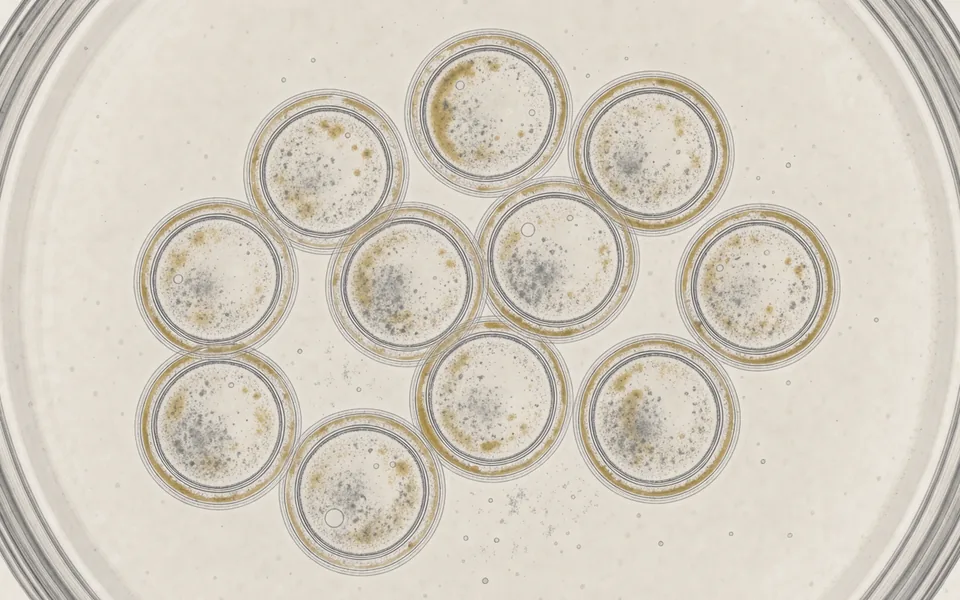
Another experiment asks a very local question about ageing. The 2022 mouse-oocyte study used 0.1 mM Epitalon in vitro and reported lower reactive oxygen species and modulation of mitochondrial activity, preserving oocyte quality at 6, 12 and 24 hours after ovulation.
Those are egg cells outside the animal, followed over hours. I appreciate the small scale of the question: a defined kind of cell damage, in a defined setting. It earns its place in the story without having to carry a claim about whole-body rejuvenation.
Survival in female SHR mice
The female Swiss-derived SHR mouse experiment reported a 12.3% increase in maximum lifespan and a 13.3% increase in survival of the last 10% of the cohort. Mean lifespan was unchanged. Bone-marrow chromosome aberrations fell 17.1%; leukaemia was inhibited 6.0-fold, while total tumour incidence was unchanged.
The combination is more interesting than a single “longer life” headline. An extreme survival result changed, the average did not, and the disease findings differed too. It would take functional testing alongside survival to answer how those animals spent the additional time.
Human observations with Epithalamin
The observational cohort of 266 elderly people ran for six to eight years and used the parent pineal preparation Epithalamin, alone or with thymalin. The pineal preparation alone was associated with a 1.6- to 1.8-fold mortality decrease versus untreated controls; the combination arm reported a 4.1-fold decrease.
There was no randomisation or placebo arm. Selection and other confounders can therefore contribute to the association, and the preparation differs from synthetic Epitalon. I cannot assign this mortality result to the tetrapeptide. It does explain why the pineal-peptide story has attracted such persistent interest.
Epitalon safety
Epitalon has no FDA, EMA or MHRA approval and no registered indication. There is no published human pharmacokinetic study and no randomised long-term human safety trial. The recent overview also describes limited structural and physico-chemical characterisation and uncertainty about whether the proposed mechanisms are the only ones operating.
The telomerase and ALT findings add an unresolved cancer-related concern. Specific rodent tumour experiments cannot settle general oncological safety in people. The breast-cancer cell-line finding deserves to remain beside the appealing telomere result wherever that result is discussed.
Community accounts describe deeper sleep, steadier day-night rhythms, more daytime energy or a general feeling of well-being. These are anecdotal accounts, not clinical evidence. Many people report no noticeable effect. Other accounts mention redness, soreness or bruising at injection sites, drowsiness, vivid dreams, mild headache or lightheadedness; causation is unverified, and the complaints do not amount to a controlled safety profile. No dose or schedule can be inferred from them.
Familiarity makes sleep stories persuasive. Their uncontrolled design still leaves the clinical question open. The human evidence still needs to connect a defined preparation with a measured benefit and a credible account of harms.